|
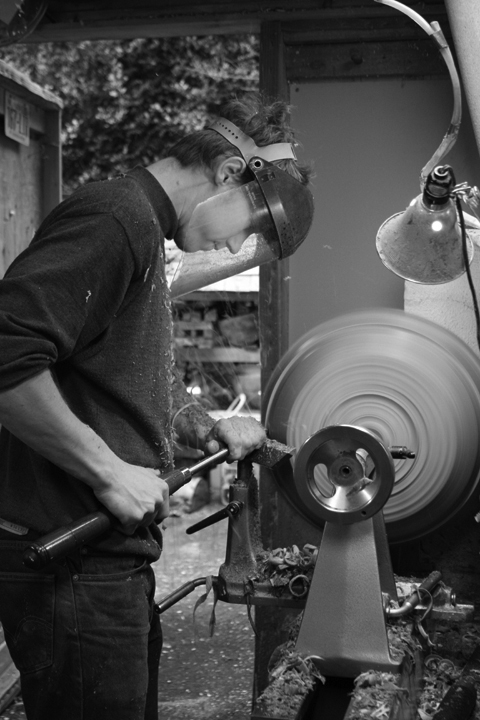
Turning a bowl.
Preparation:
Finding wood is not always easy. Luckily, the more
years I do this, and show my work at craft shows,
the more kind people offer me a freshly felled tree.
Once the wood is cut, loaded in my truck, and brought
to my shop, I have to use it soon. If not, it will
split and crack due to uneven drying.
The round is cut in half lengthwise, then corners
are removed, leaving me with a rough—looking
octagonal shape.
Roughing out
This blank is bolted to a heavy steel face plate,
which securely threads onto my lathe. I begin
cutting at a slower speed, Roughing out a
round form. Once I’ve cut past all bark and
defects, I begin the fun part – creating the shape.
Every time I make a bowl, I get to play
the role of designer and manufacturer.
It's always challenging balancing several variables
at once. If the wood is gorgeous, I try to keep things
simple to showcase it's color and grain. If it is
straight-grained, I play around more with form and surface
decoration. Weight and and wall thickness are also important. I
often make the rim a little thicker than the rest of
the bowl. This makes the bowl stronger, and easier to
pick up. Some turners will make a bowl's foot deep and
ornate. I generally avoid this, and opt instead for a
simple, shallow foot. This makes the bowl stronger, and
easier to wash and dry.
While shaping the bowl, long, curly shavings and wet sap
fly around everywhere. If a piece of wood has a good or
bad smell to it, this is when you find out. Once I shape the
outer profile, I unbolt the bowl, and flip it around, grabbing it
in a 4-jaw chuck. This gives me access to the inside of the bowl.
Completing the inside curve is challenging. Keeping a consistent
wall thickness on a larger bowl is never easy. It requires
frequent measuring with calipers.
Throughout the process, I sharpen my tools a lot.
This is especially important before I take the last few cuts on a surface. Sharpening so much may take a little longer
initially, but getting a near perfect surface to start
with makes finish sanding much easier.
Once the bowl is shaped, I'm left standing knee deep in a sea
of moist wood shavings.
The bowl is now removed from it’s chuck, and
flipped around again. I sandwich it between a smaller bowl,
mounted in my chuck, and the tail-stock center. This
allows me to complete the shaping of the foot.
The bowl is dried slowly, first in an open air shed, next in
my heated shop. The process takes anywhere from one week on a
featherweight bowl to over a year to dry a very thick one.
Once dry, I sand the bowls by hand, and using a beefed-up
version of a dentist's flexible shaft. As you might imagine, this is my least
favorite part of the process. I wear a respirator that sends me clean air from outside my shop, and rely on my music collection to keep me from talking to myself. Once I've removed all scratches, and the surface is silky-smooth,
I brand my initials in the bottoms, and rub the bowls down with grocery store walnut oil. This particular oil dries completely, and does not go rancid. It also has a neutral taste and smell. I recommend it for re-oiling any wood kitchen wares. Mineral Oil is less expensive, and supposedly food-safe, but it doesn't soak in as deeply, and is a petroleum product.
Marketing
Finally, I market my bowls through craft shows, galleries, my web site, the Vashon Studio tours, and our Saturday Farmer's Market.
About Lathes
All of my work is turned on a wood lathe. For those who aren’t familiar with this machine - it's been around for at least several thousand years. The material to be worked is affixed to the headstock. This is a heavy mass of wood, metal, or concrete, housing a shaft mounted in bearings. It allows a workpiece to be rotated at various speeds. Work can also be held between the fixed headstock, and an adjustable tail-stock, which allows for turning longer pieces. By human power, water power, or electric motor, the material to be worked is spun round and round, enabling the turner to shape it with various cutting tools and abrasives. A movable tool rest gives more support to the tool shaft, allowing more leverage and thus better control.
Lathes can be rough and ready, able to shape wood by foot-power, or can be extremely accurate, with computer controlled lathes turning precision parts out of various metals. Lathes can be used to shape just about any rigid material.
Chances are you have plenty of lathe-turned objects in your home: chair or stair rungs, knobs, wood bowls, mortar and pestles, parts inside your computers, - shafts and other parts in your washer, dryer, or inside your in your car's engine. Even the patterns for your ceramic dishes were likely lathe-turned.
Why have I chosen to work with wood? Most of the things I create come from trees that would otherwise become firewood. Spending some of my time hunting for wood is more fun, and less limiting than buying from lumber yards. Wood has a warmth, charm, and personality unlike any man-made material. This is because it once was a living organism, not so unlike you or me.
|